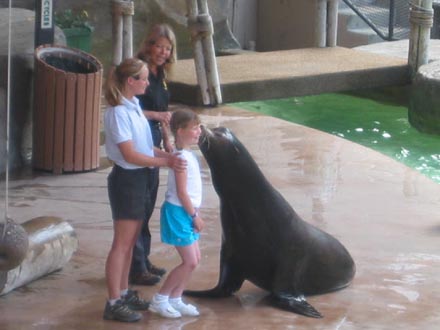
 Some species of sea lion are readily trainable and are often a popular attraction at zoos and aquariums. The archetypal circus "seal" performing behaviors such as throwing and catching balls on its nose and clapping is almost always a sea lion.
Sea lions have been trained by the U.S. Navy's Marine Mammal Program, based in San Diego, to detain scuba divers.
 Sea lion attacks on humans are rare. In a highly unusual attack in 2007 in Western Australia a sea lion leapt from the water and seriously mauled a 13-year old girl surfing behind a speedboat. The sea lion appeared to be preparing for a second attack when the girl was rescued. An Australian marine biologist opined the sea lion may have viewed the girl "like a rag doll toy" to be played with. In San Francisco where an increasingly large population of California sea lion crowds dock along San Francisco Bay, there have been incidents in recent years of swimmers being bitten on the leg by large aggressive males, possibly as a territorial act.
The Moche people of ancient Peru worshipped the sea and its animals. They often depicted sea lions in their art.
 Sea lions have also been reported to assist or save humans who show signs of distress in the open waters. In June of 2000, Kevin Hines leaped into the San Francisco bay and it was reported that he was saved by a sea lion that kept him afloat and breathing till the paramedics arrived.
[ READ MORE ]
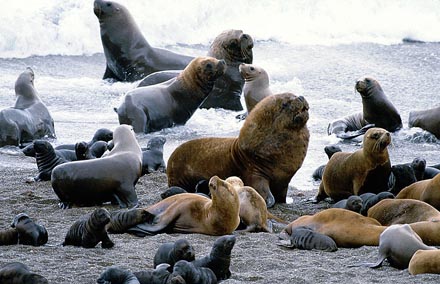 Mating occurs between August and December, and the pups are born between December and February. Males arrive first and defend territories, but switch to female defense as they were joined by them. Males defend females from neighbours and intruders with threat displays and by fighting, and forcefully hold pre-estrous females near them. On rocky beaches, males defend small territories where females aggregate and herd them. On more open cobble or sandy beaches, males stay along the surf line and try to herd females going to sea to cool down or forage. The number of actual fights between males depends on the number of females in heat. The first males to arrive have the longest tenures and achieve the most copulations. Males are usually able to keep around three females in their harem, but some have as many as 18.
 During the breeding season, males that fail to secure territories and females (mostly subadults) will cause group raids in an attempt to change the status-quo and gain access to the females. These raids cause chaos in the breeding harems, often splitting mothers from their young. The resident males are unable to fight off all the raiders and keep all the females in their territorial boundaries. Nevertheless, raiders are often unsuccessful securing a female. Sometimes an invading male will abduct pups, possibly as an attempt to control the females. They may also take pups as substitutes for mature females. Pups are often severely injured or killed when this happens. Group raids are more common on sandy beaches than rocky ones.
 Sea lion mothers remain with their newborn pups for nearly a week, and then start a routine of taking trips back into the sea for food and coming back to nurse the pups. They will act aggressively to other females who come close to their pups, as well as alien pups who try to get milk from them. Pups first enter the water at about four weeks and are weaned at about 12 months. This is normally when the mother gives birth to a new pup. Pups gradually spent more time in the nearshore surf and develop swimming skills.